


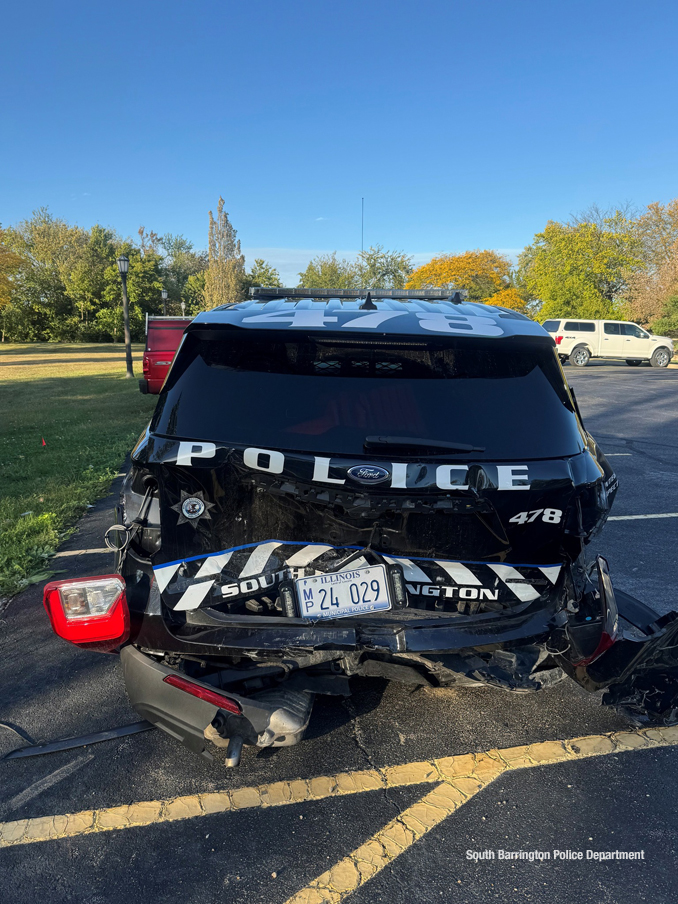
The Village of South Barrington released information Wednesday, October 22, 2025 that one of their marked police SUVs was damaged in a crash caused by a Tesla in autopilot mode that was occupied by a sleeping motorist. Fortunately, the two South Barrington officers involved as victims in the crash did not sustain serious injuries.
The South Barrington Police Department police SUV on Wednesday, October 15, 2025 was struck in the rear-end by a Tesla that was being operated in autopilot mode, according to the Village of Barrington.
The driver of the Tesla admitted to falling asleep while the vehicle was on autopilot, according to the Village of South Barrington. The individual was subsequently arrested and charged with several violations by the Barrington Hills Police Department.
Barrington Hills Police Department is investigating the incident. The crash cause moderate to severe damage to the rear-end of the South Barrington Police Department Ford Interceptor SUV.
“The South Barrington Police Department would like to remind all motorists that while the use of vehicle automation systems such as autopilot is not illegal, drivers are still required to remain alert and attentive at all times. Vehicle technology can assist drivers, but it does not replace the need for human attention and judgment behind the wheel.”
— South Barrington Police Department
“Technology continues to evolve and can enhance safety when used properly,” said Deputy Chief Puralewski. “However, it’s important to remember that drivers are still responsible for the safe operation of their vehicles at all times.”
The South Barrington Police Department urges all drivers to stay focused, avoid distractions, and maintain control of their vehicles to help keep our roads safe for everyone.
The location and time of the crash wasn’t provided, and the level of details didn’t include why the Tesla’s Vision-Based Attention Monitoring System failed to prevent the crash.
A Tesla detects an inattentive driver using a Vision-Based Attention Monitoring system, which relies on the cabin camera. When using Autopilot or Full Self-Driving (Supervised), this system works in conjunction with steering wheel torque sensors to ensure the driver remains focused and ready to take control.
Key components of the Vision-Based Attention Monitoring System:
Cabin Camera
Located above the rearview mirror in most newer Tesla vehicles, this camera monitors the driver’s head movements and eye gaze. It can detect if the driver is repeatedly looking away from the road, using a handheld device, or showing signs of drowsiness, such as frequent yawning or blinking.
Steering Wheel Torque Sensor
This older method requires the driver to apply slight force to the steering wheel at regular intervals. If the system detects a lack of force for too long, it issues a “hands on wheel” reminder.
Driver Drowsiness Warning
A specific alert that triggers if the camera and driving patterns indicate the driver is drowsy. It provides visual and audio warnings to encourage the driver to pull over or become more attentive.
How the Vision-Based Attention Monitoring System responds to inattentiveness
When inattentiveness is detected, the system issues a series of escalating warnings …
Visual and audible alerts prompt the driver to refocus on the road.
Repeatedly ignoring these warnings results in an “Autopilot Strikeout,” and the system is disabled for the remainder of the drive.
Accumulating multiple strikes (the number depends on the car’s configuration) can lead to a suspension of Autopilot and FSD features for an extended period, such as one week.
For newer systems on FSD (Supervised), the cabin camera is the primary method for monitoring driver attention, with the steering wheel nags acting as a fallback if the camera’s view is obstructed.
Occasionally, Tesla updates the Vision-Based Attention Monitoring System, correcting over-reactive responses by the system or under-reactive responses by the system.
