


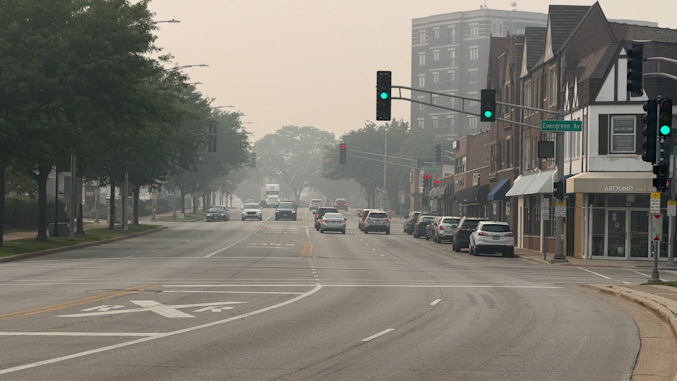
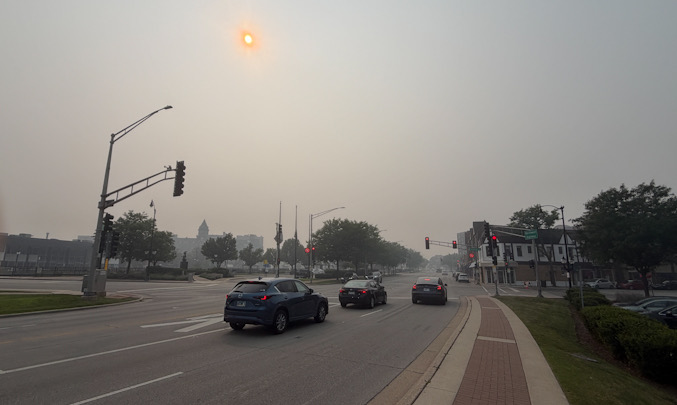
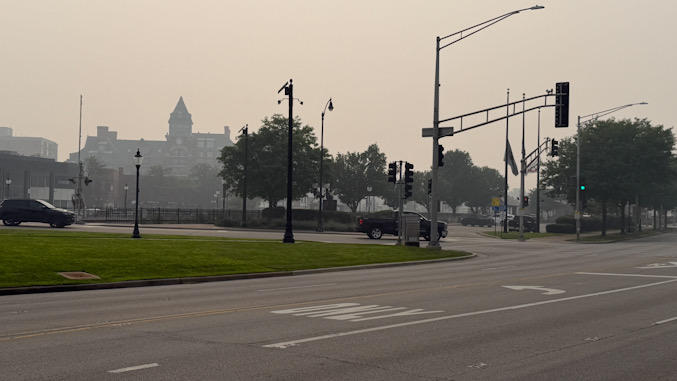
The hazy smoke covering Chicago was the worst in areas north of Interstate 90, and weather conditions spread the smoke from hundreds of active wildfires burning in Canada, and in Minnesota near the border. The jet stream sent smokey air directly south into the upper Midwest, and especially southern Wisconsin and northeast Illinois.
Wildfire smoke exposure can cause immediate brain fog, headaches, and mood disturbances. Additionally wildfire smoke can cause long-term respiratory system, cardiovascular system, and nervous system health problems, and even fatalities.
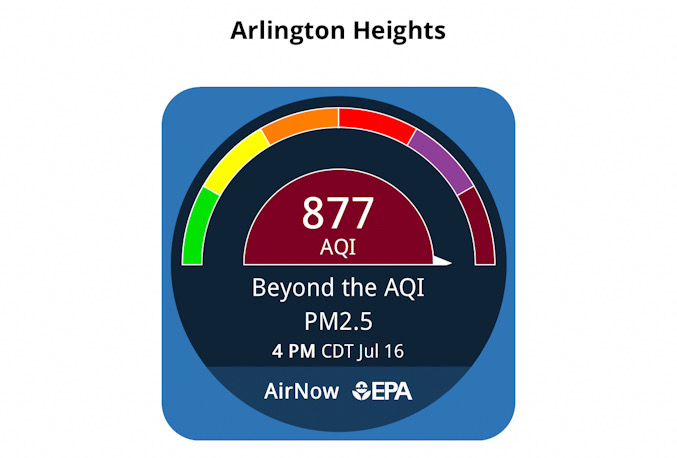
Over 100 intense wildfires are burning in July 2026 in the provinces of Manitoba and Ontario (Central and Southern Canada), with some wildfires burning out of control many in heavily wooded (high vegetative fuel) areas. Additional fires are active further west in Saskatchewan. In Northern Minnesota, wildfires were burning near the Canadian border, including around the Boundary Waters Canoe Area Wilderness. All of these areas of fire were contributing smoke plumes to reach as far south as northeast Illinois that caused a record-breaking poor Air Quality Index (AQI) of 900 “Hazardous” to all populations of individuals — people with pre-existing conditions and healthy individuals.
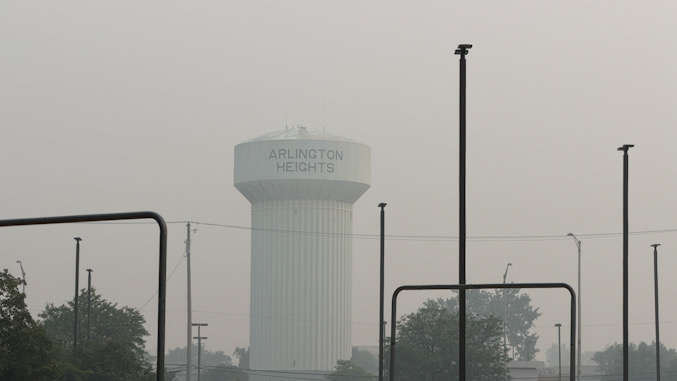
A stagnant high-pressure system over northeast Wisconsin Thursday morning, July 16, 2026, and over Upper Michigan Thursday afternoon functioned as an atmospheric dome, which trapped Canadian wildfire smoke near the ground instead of dispersing in the atmosphere. The high pressure system, combined with hot, stagnant weather, caused shattered air quality records on Thursday, July 16, with the PM2.5 AQI indices from the upper 600s in Chicago to 900 in some northern suburbs, which translated to hazardous levels for unhealthy and healthy populations.
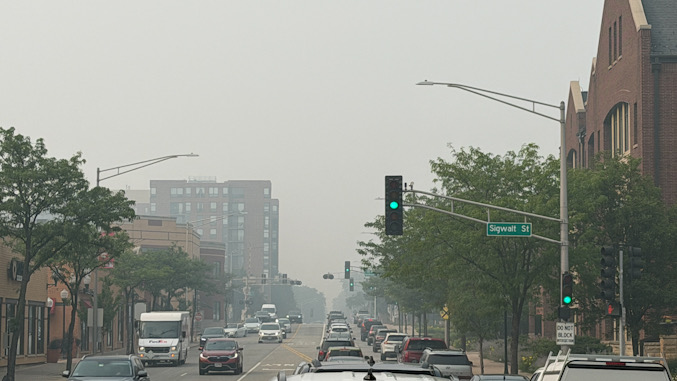
The high pressure system created a temperature inversion layer, that put an atmospheric lid over northern Illinois, which caused the heavy particulate matter in wildfire smoke to sink toward ground level. Visibility was reduced, and unhealthy air settled in northeast Illinois causing Chicagoland air to be classified as the most polluted air in the world for Thursday, July 16, 2026.
The air quality improved Friday, July 17, 2026, but was still at the “Hazardous” AQI rating in the 300s in Arlington Heights Friday morning, and then improved to “Very Unhealthy” in the 200s after noon. Saturday is forecast to improve to “Moderate” in the 50 to 100 range.
Health Impact of Wildfire Smoke
Wildfire smoke (WFS) contributes to the deterioration of air quality, resulting in increased exposure to air pollution especially in wildland-urban interfaces. WFS contains particulate matter (PM) in a range of sizes and chemical compositions, as well as multiple toxic gasses.
The health impacts of WFS are systemic, affecting the respiratory, cardiovascular, and neurological systems. Exposure to WFS is associated with inflammatory and oxidative stress, DNA damage, epigenetic modulations, and stress-disorders in adults and children. Children may be at an increased risk of WFS respiratory impacts, due to their smaller airways and developing lungs.
Epigenetic modulations refer to reversible chemical changes that turn genes “on” or “off” without altering the underlying DNA sequence. Some epigenetic changes increase cancer risk.
Impact on Respiratory System
Wildfire smoke affects the respiratory system by triggering inflammation, oxidative stress, and irritation as microscopic particles penetrate deep into the airways and alveoli.
WFS exposure leads to immediate symptoms like coughing, wheezing, and shortness of breath, and can severely exacerbate chronic conditions such as asthma and Chronic Obstructive Pulmonary Disease (COPD). The health effects range from mild to severe, depending on the length of exposure and underlying health status.
Airway Irritation occurs when a toxic mix of gases and chemicals, such as carbon monoxide and nitrogen oxides, immediately irritates the mucous membranes in your nose, throat, and sinuses. The irritation can cause a scratchy throat, burning feeling, runny nose, and dry cough.
The greatest danger of WFS comes from Deep Lung Penetration of Particles — fine particulate matter (PM2.5). These microscopic particles are small enough to bypass the body’s natural defenses, traveling deep into the tiny air sacs (alveoli) of your lungs where gas exchange occurs. Once the particles settle deep in the lungs, these pollutants cause tissue inflammation and oxidative stress, which can lead to reduced lung function, painful breathing, and chest tightness, and exacerbation of Pre-existing Conditions, including asthma, COPD, or bronchitis. WFS can trigger severe flare-ups or acute attacks that require medical intervention.
Impact on Cardiovascular System
Exposure to wildfire smoke has been shown to increase cardiovascular-related health issues such as acute myocardial infarction, cardiovascular mortality, cardiovascular emergency department visits and hospitalization, cardiac arrest, as well as heart failure. People with pre-existing conditions
Wildfire smoke affects the cardiovascular system primarily through the inhalation of fine particulate matter, specifically PM2.5. These microscopic particles reach deep into the lungs and alveoli (the air/bloodstream interface) and cross into the bloodstream. Once particles are in the bloodstream, they trigger systemic inflammation, oxidative stress, cytokine release, worsening endothelial dysfunction, and hypercoagulability (an increased tendency of the blood to form clots caused to an imbalance in the body’s clotting and clot-dissolving mechanisms. Even acute (short term) exposure to PM2.5 particle pollution is associated with increased cardiovascular morbidity and mortality.
PM2.5 refers to microscopic airborne particles ≤ 2.5 micrometers in diameter (roughly 30 times smaller than a human hair). Because PM2.5 particles are so small, they evade the body’s natural defenses, embedding deep into the lungs with the capability to cross the alveolar membrane and enter the bloodstream. When PM2.5 particles get into the lungs and into the bloodstream there are health risks to the respiratory system, the cardiovascular system, and the nervous system. The PM2.5 particle pollutant is primarily generated by combustion processes such as vehicle exhaust, power plants, and wildfires. PM is the abbreviation for Particulate Matter.
Oxidative stress is an imbalance between unstable molecules called free radicals and the antioxidants that neutralize them. When free radicals outnumber antioxidants, they damage DNA, lipids, and proteins, which can accelerate aging and contribute to chronic conditions like cardiovascular and neurodegenerative diseases.
Cytokin Release Syndrome (CRS) involves targeted immune cells (such as T-cells) that become highly activated and release signaling proteins called cytokines. These cytokine proteins act as a positive feedback loop, rapidly recruiting and activating other innate immune cells (like macrophages and endothelial cells) in an uncontrolled inflammatory response. Interleukin-6 (IL-6) plays a central role in driving many of the severe symptoms, which include high fever, fatigue, muscle and joint pain, headache, dangerously low blood pressure, difficult breathing with hypoxia (low oxygen levels), and rapid heart rate. Advanced complications of Cytokin Release Syndrome include capillary leak syndrome and multi-organ failure (kidney failure, liver failure, and lung failure).
Endothelial Dysfunction is a systemic condition where the inner lining (endothelium) of blood vessels fails to function normally. Endothelial Dysfunction is associated with reduced nitric oxide (NO) production, and resulting blood vessel constriction and narrowing. Nitric oxide is a molecule known for improving vasodilation (dilation of blood vessels), which is a healthy situation. The poor condition of the endothelium leads to turbulence in the blood stream, inflammation, blood clotting and plaque formation inside the blood vessels (including coronary arteries), and is a primary precursor to atherosclerosis and heart disease.
Atherosclerosis is a slow developing disease (from as early as childhood) characterized by the buildup of fatty deposits called plaque inside arteries Plaque and narrowed or constricted blood vessels restricts blood flow and oxygen to vital organs. Atherosclerosis is a leading cause of cardiovascular complications like heart attacks (myocardial infarction) and strokes. Atherosclerosis is typically triggered by damage to the inner lining of an artery. Once the wall is injured, fats, cholesterol, cellular waste, and calcium accumulate at the site of the injury.
Smoke particles cross the lungs to the bloodstream; these ultrafine particles can cross the alveolar membrane and enter the bloodstream. This causes systemic inflammation that can affect cardiovascular health and increase the risk of serious medical emergencies.
Impact on Nervous System
Wildfire smoke affects the nervous system when toxic fine particulate matter PM2.5 and gases bypass the blood-brain barrier. Particles and toxins that cross the blood brain barrier trigger systemic oxidative stress, chronic neuroinflammation, and oxygen deprivation. Symptoms include immediate brain fog, headaches, and mood disturbances. Wildfire smoke also increases the long-term risk of dementia and cerebral stroke.
Note: Apple iPhone readings of Air Quality Index (AQI) tended to report lower than readings publish by AirNow.gov.
CARDINAL NEWS maintains an air quality page at Arlingtoncardinal.com/air
There is a link to the air quality page from the AQI link just under the 7-day high/low temperature forecast on the front page of CARDINAL NEWS – Arlingtoncardinal.com.
Get updates from The Cardinal ALL NEWS FEEDS on Facebook. Just ‘LIKE’ the ‘Arlington Cardinal Page (become a fan of our page). The updates cover all posts and sub-category posts from The Cardinal — Arlingtoncardinal.com. You can also limit feeds to specific categories. See all of The Cardinal Facebook fan pages at Arlingtoncardinal.com/about/facebook …
Help fund The Cardinal Arlingtoncardinal.com/sponsor
SOURCES:
Rizzo LV, Rizzo MCFV. Wildfire smoke and health impacts: a narrative review. J Pediatr (Rio J). 2025 Mar-Apr;101 Suppl 1(Suppl 1):S56-S64. doi: 10.1016/j.jped.2024.11.006. Epub 2024 Dec 13. PMID: 39681318; PMCID: PMC11962561.
Lei Y, Lei TH, Lu C, Zhang X, Wang F. Wildfire Smoke: Health Effects, Mechanisms, and Mitigation. Environ Sci Technol. 2024 Dec 3;58(48):21097-21119. doi: 10.1021/acs.est.4c06653. Epub 2024 Nov 8. PMID: 39516728.
Hadley MB, Henderson SB, Brauer M, Vedanthan R. Protecting Cardiovascular Health From Wildfire Smoke. Circulation. 2022 Sep 6;146(10):788-801. doi: 10.1161/CIRCULATIONAHA.121.058058. Epub 2022 Sep 6. PMID: 36067276.
Heibati B, Renz H, Lacy P. Wildfire and wood smoke effects on human airway epithelial cells: A scoping review. Environ Res. 2025 May 1;272:121153. doi: 10.1016/j.envres.2025.121153. Epub 2025 Feb 20. PMID: 39986423.
