


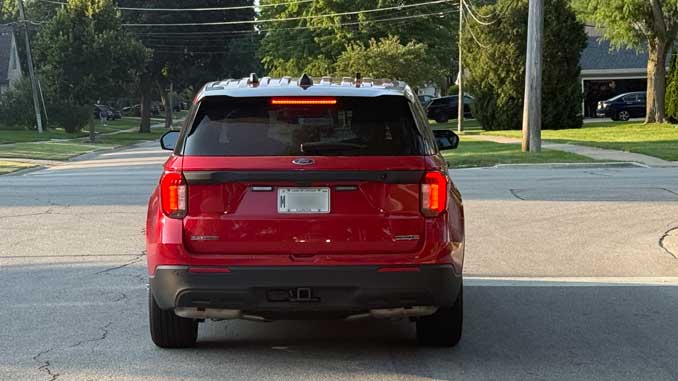
State traffic laws and department rules strictly regulate the use of emergency lights and sirens for police officers and firefighters. Lights and sirens are only legally permitted when responding to a bona fide emergency call or during specific, hazardous situations on the road.
Firefighters work 24 hours a day, and fire chiefs are often on-call 24 hours a day, but what if a fire chief — called to a reported house fire at the end of his or her 9 to 5 work day — is unassigned because the fire is out, but continues with lights and sirens activated to go to his personal home where he lives?
Is this wrong? Is it unacceptable? Is it punishable? Is it a privilege perk that is part of the job?
Technically, it is wrong to use emergency lights and sirens while not responding to a bonafide emergency. Using lights and sirens while simply driving home without an active, assigned emergency is a violation of state law and fire department policy. Activated lights and sirens are only legally permitted when responding to a bona fide emergency call or during specific, hazardous situations on the road, which is specified in Illinois Statutes Chapter 625. Vehicles § 5/12-215. Once an incident is called off or downgraded by dispatch, the emergency no longer exists for some or all units, meaning the legal justification for using lights and sirens is terminated.
Why traveling with emergency lights without an active emergency is an issue …
If an accident occurs while a fire chief is running lights and sirens for a non-emergency purpose, the chief and the department can be held personally and civilly liable for negligent driving. A devastating crash with a fatality or debilitating injuries could result in a lawsuit with high financial loss to a municipality.
Consider some examples …
A fire chief — traveling with activated lights and sirens with no bonafide emergency — passes an intersection with 4-way stop sign without stopping, and crashes with a speeding e-bike rider that illegally ran a 4-way stop sign in cross traffic; and the crash kills the e-bike rider.
A fire chief traveling with activated lights and sirens with no bonafide emergency takes action to avoid a crash with a speeding e-bike rider, but crashes with another motorist, or crashes into a house, causing property damage, personal injury, or a fatality.
Consider additional issues …
Misusing emergency lights and sirens can cause other crashes that don’t involve the fire chief, but are caused by motorists over-reacting to the fire chief’s lights and sirens.
Misusing emergency lights and sirens lowers quality of life in a community when unnecessary sirens contribute in excess to daily sirens in the community.
Misusing emergency lights and sirens creates unnecessary public stress and panic, unnecessary city noise, and can erode public trust.
Is inapropriate use of emergency lights activation punishable?
Fire departments usually have strict Standard Operating Guidelines (SOGs) or Standard Operating Procedures (SOPs) outlining exact rules for running “hot” or traveling with lights and sirens activated. An unassigned response or returning home with lights and sirens is typically a punishable offense that can lead to disciplinary action, suspension or termination.
Many accidents occur when emergency vehicles are passing through streets or through intersections. Here are some safety tips for reacting to emergency vehicles with lights and sirens activated …
Stay calm, don’t panic, and beware of other panicked drivers.
In the simplest situations, it is best to use your right turn signal and move to the right side of the road.
React appropriately and don’t judge whether or not the approaching emergency vehicle is responding to a bonafide, active emergency.
Normally, you should stop to allow the emergency vehicle to pass. However, there are times when the driver of an emergency vehicle in congested traffic will want to use the lane you are obstructing, and will increase the use of a siren or air horn. In that case, advance and move slowly and carefully while looking for cross traffic, and watch for other drivers that may panic and move quickly into your path.
When multiple emergency vehicles pass you on a straight route with lights and sirens activated, don’t assume that every emergency vehicle is going to take that straight route. Remain stopped, because any one of the drivers of additional emergency vehicles may want to turn left in front of you, or make a right in front of you immediately after passing you, when they are in a left lane and you are in a right lane.
Especially when you are near an intersection on a four-lane road, pull over and stop before the intersection in case the driver of the emergency vehicle wants to turn at that intersection.
Beware of additional emergency moving through an area from any direction. Many emergency responses involve multiple emergency vehicles traveling in series in the same direction, or possibly from other directions.
Avoid stopping in an intersection. Plan ahead when you see an emergency vehicle approaching, so you avoid stopping in an intersection.
When it is safe to move again and you want to begin to move in traffic, beware of motorists that didn’t pull over and want to overtake you in traffic. Also, beware of motorist who pulled over behind you, and want to overtake you in traffic.
Get updates from The Cardinal ALL NEWS FEEDS on Facebook. Just ‘LIKE’ the ‘Arlington Cardinal Page (become a fan of our page). The updates cover all posts and sub-category posts from The Cardinal — Arlingtoncardinal.com. You can also limit feeds to specific categories. See all of The Cardinal Facebook fan pages at Arlingtoncardinal.com/about/facebook …
Help fund The Cardinal Arlingtoncardinal.com/sponsor
