


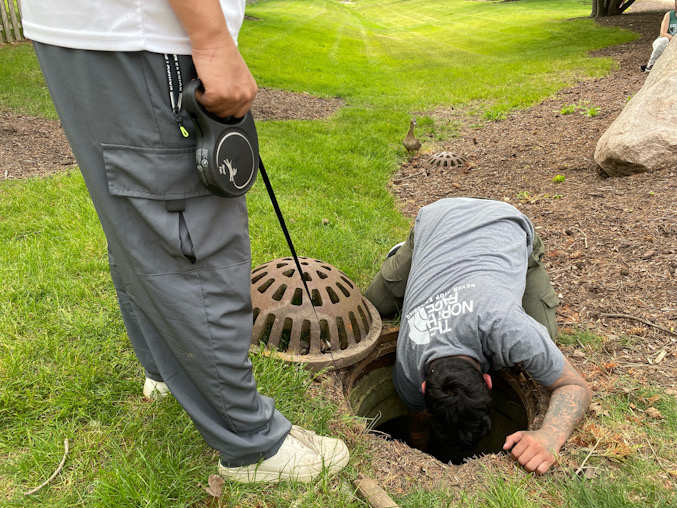
Today CARDINAL NEWS presents some progressive clarification of yesterday’s article about the failure of the Village of Arlington Heights to respond to a call to rescue ducklings from a storm sewer near Wilke Road and Pheasant Trail on Sunday afternoon, May 17, 2026. The Village of Arlington Heights minimally should have assessed the scene security with an on-scene authority, marked off the manhole as a hazard, and notified the individuals that were attempting the rescue that they should not enter the storm sewer. Hopefully, authorities would also rescue the ducklings utilizing firefighters, as many other communities do. Apparently, the 911 center, Northwest Central Dispatch System (NWCDS) never assigned a rescue call or non-emergency service call to the fire department because the fire department policy denies rescue of ducklings.
There are several issues in this incident that require further explanation.
Number 1
Extra assurance for scene security and safety to residents was necessary, but was not performed. When residents learned that there would be no response from the Village of Arlington Heights, they attempted to partake in a rescue themselves. Fortunately, the citizen rescuers that attempted the ducklings rescue had the good sense to stay above ground during the 90-minute attempt to rescue ducklings about 10 feet below ground in a storm sewer. A below ground rescue in a storm sewer is risky and dangerous. The scene where the ducks were entrapped was deeper than many scenes we see in the news where the ducklings can be scooped up by hand while leaning over the manhole. Sunday’s rescue would have required an extra long scoop, or would have required someone to enter the barrel and climb down the fixed ladder to get the ducklings.
Without Personal Protective Equipment (PPE), going down the storm sewer barrel hole, especially a 10-foot deep hole, has dangerous risks of …
loss of consciousness and asphyxiation if low oxygen or contaminated air (Hydrogen Sulfide, Methane, Carbon Monoxide) conditions exist,
slip and falls that could cause a fracture and/or lacerations with exposure to water or mud that is contaminated with viral and bacterial organisms,
chemical exposure from chemical wastes illegally dumped into the storm sewer, and
sudden engulfment with rising water from an unexpected water source that could cause drowning.
Due to these risks, there are OSHA requirements for workers entering storm sewers. OSHA classifies storm sewer systems as “permit-required confined spaces”. Entry requires a strict safety program, including certified training, continuous atmospheric testing, and a dedicated safety attendant on the surface near the entry hole.
The air must be tested with a calibrated instrument for oxygen levels (which must be 19.5% – 23.5%), flammable gases/vapors, and toxic gases (e.g., hydrogen sulfide or carbon monoxide) before and during entry.
At least one trained attendant must continuously remain stationed immediately outside the storm sewer (above ground) for the duration of the entry to monitor conditions, maintain communication, and summon emergency rescue.
Workers entering the confined space must wear a chest or full-body safety harness with a retrieval line, unless the employer can demonstrate that using a safety harness is infeasible. Employers must have a designated rescue procedure in place. For example, the retrieval line that firefighters use is connected to winch on a tripod that is placed over the hole. If a worker collapses in the storm sewer, workers at the surface can pull the incapacitated worker to the surface.
Workers must continually monitor for engulfment risks (such as flash flooding from upstream runoff) and ensure barriers are placed around openings to protect workers from external hazards, such as tools falling into the hole.
Number 2
The optics for the Village of Arlington Heights was bad in this incident. People are accustomed to seeing news stories where firefighters rescue ducklings from storm drains and storms sewers, so they were surprised to discover that Arlington Heights would not respond. Just three days prior to the May 17th incident in Arlington Heights, Buffalo Grove firefighters on May 14th rescued nine baby ducklings that had fallen into a storm drain on Satinwood Court — about 3.4 miles (as the ducks fly straight line) northeast of the Arlington Heights scene at Wilke Road and Pheasant Trail.
The Buffalo Grove incident was published on the Village of Buffalo Grove official Facebook page.
“Not your everyday rescue! 🐤🚒🥺
On Thursday morning, Station 27 Lieutenant Beckman and Firefighter/Paramedics Petersen and Baniqued responded to a call from a passerby on Satinwood Court who heard the chirps of nine baby ducklings that had fallen into a storm drain.The three of them were able to pluck each of them out safely and reunite them with mama duck. 🦆❤️
No rescue is too small for BGFD! 🙌”
— Village of Buffalo Grove
The Buffalo Grove handling of their incident may have been part of the reason for higher expectations from the Arlington Heights Fire Department. It is important to note that had an Arlington Heights duckling rescue occurred, the Arlington Heights incident involving a deeper hole, may have required a firefighter to wear Self-Contained Breathing Apparatus, a safety harness with a retrieval line, and other Personal Protective Equipment (PPE). Obviously, the incident would not have been safely handled by the animal control officer, unless it could have been performed safely with a long scoop-like tool from above ground.
One reader of yesterday’s article noted that Arlington Heights and Buffalo Grove are both served by the Northwest Central Dispatch System 911 center (NWCDS), indicating that NWCDS might have a separate procedure involving ducklings rescue for Arlington Heights compared to Buffalo Grove.
Number Three
The CARDINAL NEWS didn’t criticize the Arlington Heights Police Department, and didn’t criticize police officers or firefighters, who probably weren’t even aware of the incident on Sunday, May 17, 2026. There was criticism of the policy of the Arlington Heights Fire Department and the Village of Arlington Heights. The CARDINAL NEWS article actually praised the police desk personnel for providing extra effort to set up a wildlife referral to rescue the ducklings. Two commenters on Facebook tried to gaslight CARDINAL NEWS, indicating an estranged relationship with the police department. The commenters were casually working together and both provided incorrect statements about yesterday’s article. Additionally, one of the collaborating commenters indicated the article was extensive (and needed Cliff Notes), and the other indicated the article had scant details. Both of those commenters are now blocked from receiving feeds and commenting on CARDINAL NEWS social media. CARDINAL NEWS has a low tolerance for Facebook commenters that provide false information attempting to degrade the community experience of understanding an incident and related issues.
Number Four
The Arlington Heights Fire Department has previous experience with storm sewer incidents, and should have been better prepared with a useful policy explanation for duckling rescues and storm sewer safety. One incident in particular nine years ago involved Arlington Heights police and firefighter/paramedics responding about 2:21 p.m. Friday, May 26, 2017 to a report that three kids were trapped in a sewer. Firefighters soon discovered that the kids were not trapped but had entered the sewer or drainage tunnel culvert near the pedestrian bridge at Camelot Park, and walked north underground. A resident in the block of 2700 North Dryden Place, just north of Hintz Road heard the kids talking underground as the children were walking in the drainage sewer that feeds a nearby creek. Police officers found the children exiting the storm sewer a significant distance (blocks away) from where the firefighters were operating.
Additionally, the Arlington Heights Fire Department needs to be more proactive and transparent with providing news of incidents and policies. This would be a good opportunity to explain to the public the hazards of storm sewer drainage systems and duckling rescues. The Arlington Heights Fire Department does not have its own Facebook page, and fire department information that is presented is usually fluff news that is provided on the Village of Arlington Heights Facebook page. An insider in the Village of Arlington Heights told CARDINAL NEWS that the Village of Arlington Heights management doesn’t trust the public relations/communications capabilities of the fire department, and that is why the Arlington Heights Fire Department doesn’t have their own Facebook page. Nationwide, premiere fire departments have their own Facebook pages and have their own official fire department news websites that efficiently archive fire department news, fire department policies, and incident news to provide a valuable learning experience for citizens.
VIDEO: Arlington Heights firefighters search for kids walking underground in a storm drainage sewer from approximately Camelot Park to Riley School (600-800 feet laterally underground).
On May 26, 2017, three children were lucky to have escaped an underground excursion they planned. The three children exited a drainage system near Riley School near Dryden Place and Windsor Drive, only to be met by police checking on their safety. This occurred while firefighters wearing protective gear were searching the storm drainage sewer for them several blocks away.
Confined spaces in storm drainage tunnels have several hazards and dangers that can injure or kill people in worst case scenarios. Most fatalities in confined spaces are related to atmospheric hazards.
Sewer workers are commonly exposed to gases like hydrogen sulfide, methane, ammonia and carbon monoxide. Storm drainage sewers don’t have has many chemical and noxious hazard as sanitary sewers, but some of the same gases can accumulate underground in a storm drainage sewer — gases such as methane, carbon monoxide, and hydrogen sulfide. In a study, about 53 percent of sewer workers exposed to smell that they could detect, also developed sub-acute symptoms including sore throat, cough, chest tightness, breathlessness, thirst, sweating, irritability and loss of libido.
Severity of symptoms seemed to be dose related, and hydrogen sulfide (H2S) gas apparently harms lung function. A study of exposure to hydrogen sulfide in 68 sewer workers and found that the FEV1/FVC values were lower in sewer workers who had a high H2S exposure.
FEV1 is the Forced Expiratory Volume in 1 second or the volume of air that can be forcibly exhaled in one second.
FVC is Forced Vital Capacity or the volume of air that can be forcibly exhaled after full inspiration.
Even at low concentrations, hydrogen sulfide has an irritant action on the eyes and the respiratory tract. Intoxication from H2S may be hyperacute, acute, subacute or chronic. Hydrogen sulfide enters the body through the respiratory system and is rapidly oxidized to form compounds of low toxicity that can cause symptoms such as headaches, and weakness. Heavier concentrations can cause loss of consciousness, respiratory difficulty, respiratory arrest, convulsions, and death.
Besides being overcome by hydrogen sulfide or carbon monoxide or other gas, there are risks in storm sewers from animals. Coyotes, raccoons, rats and other rodents and animals could be hazardous in a confined space. A person could be attacked by a raccoon or coyote or exposed to infectious urine or feces in the confined space. Shoes and hands could come in contact with infectious materials, a person could suffer an animal bite, or could inhale dust or mist with airborne infectious organisms. Infectious material can also be accidentally collected on a person’s shoes, or could directly infect a person from an abrasion or laceration that occurs in the sewer. Rusted corrugated steel pipes can snag clothing, cause entrapment or entanglement, cause a laceration, or poke a person in the head.
A person could also become trapped by a hole, grate or branch wedged inside the tunnel. If trapped or incapacitated somehow by an injury, the person could drown by rapid water flowing in the tunnel during the next heavy rain or diverted water. The dangerous hazard of water rising in a storm drainage sewer is known as engulfment.
Firefighters enter these spaces with self-contained breathing apparatus and other personal protection. They might not have the air flowing on the breathing apparatus, but they are ready to switch to tank air if the air monitor alarms activate and indicate they are in a dangerous air environment. During rescue operations, they are in constant communication with people above ground, and their location is tracked by extending a rope that measures how many feet have extended from their entry point.
When they exit the storm drainage sewer, they are decontaminated with a shower and their clothes are immediately washed before they proceed to any other tasks or living spaces at the fire stations.
You can imagine that a heroic citizen rescue of ducklings in a storm sewer could become much more dangerous than expected.
SOURCES:
De Serres G, Levesque B, Higgins R, Major M, Laliberte D, Boulianne N, et al. Need for vaccination of sewer workers against leptospirosis and hepatitis A. Occup Environ Med. 1995;52:505–7. [PMC free article] [PubMed]
Richardson DB. Respiratory effects of chronic hydrogen sulfide exposure. Am J Ind Med. 1995;28:99–108.
Watt MM, Watt SJ, Seaton A. Episode of toxic gas exposure in sewer workers. Occup Environ Med. 1997;54:277–80. [PMC free article] [PubMed]
Get updates from The Cardinal ALL NEWS FEEDS on Facebook. Just ‘LIKE’ the ‘Arlington Cardinal Page (become a fan of our page). The updates cover all posts and sub-category posts from The Cardinal — Arlingtoncardinal.com. You can also limit feeds to specific categories. See all of The Cardinal Facebook fan pages at Arlingtoncardinal.com/about/facebook …
Help fund The Cardinal Arlingtoncardinal.com/sponsor
